

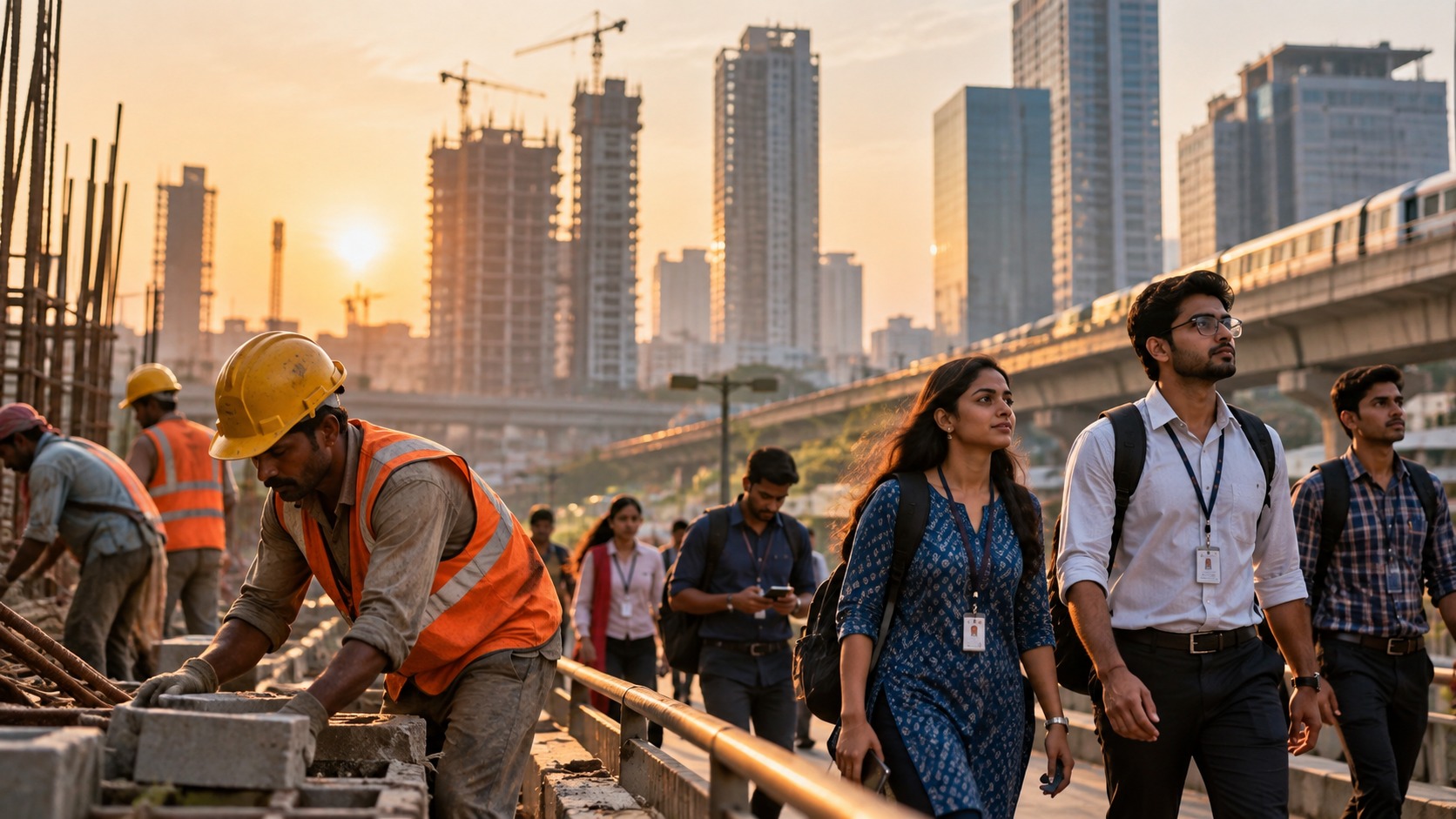
India’s latest employment data has thrown up some interesting numbers. According to The Periodic Labour Force Survey (PLFS) of 2025, self-employment declined from 57.5 per cent in 2024 to 56.2 per cent in 2025, while salaried employment rose from 22.4 per cent to 23.6 per cent.
While these numbers do reflect a distinct change in the labour market, they leave a deeper question unanswered. What is the quality of these growing jobs? After all, a job is not just employment. It is far more than that. For every employee, a job simultaneously means income, financial security, benefits, work environment, the time invested in work, and last but not the least, the possibility of building a better life and living with dignity.
From this perspective, India’s employment situation becomes far more complex. According to a 2024 report by the International Labour Organization, young Indian workers were more likely to be engaged in the informal employment sector or in vulnerable occupations compared to adults. Not just that, they also earned less than adults across various employment categories.
A country depending heavily on its young working population for a bright economic future must take this trend very seriously. What it reflects is that one worker has a permanent job with all the perks and the possibility of a promotion too, while the other does not even have a contract, no security and no certainty about his job. And yet, ironically, both are considered ‘employed’.
Among these self-employed workers, the Ministry of Statistics and Programme Implementation, Government of India (MoSPI), classified 40.5 per cent as own-account workers/employers and 15.6 per cent as helpers in household enterprises. However, this 40.5 per cent also includes self-employed people like street-vendors, small artisans and service providers with no employees.
The income figures also provide a clue. PLFS-2025 found that the average earnings of salaried employees during the year were Rs. 24,217 a month for men and Rs. 18,353 for women. Among self-employed workers, men earned Rs. 17,914 and women Rs. 6,374 on an average.
So, yes, India’s employment figures may be encouraging. But does this employment come with job/financial security and safety? Does it offer social protection and the opportunity to progress? And even more important, can this employment help build a better life for the worker? Certainly, India still needs to create crores of jobs to fulfil the ever-growing demand. But job creation alone cannot be the end. The real goal must be to ensure that this employment provides stability, dignity and mobility, not just help the worker survive.